A New Era of U.S.–China Engagement: Why the World Should Welcome It
by Naim-Ul-Karim
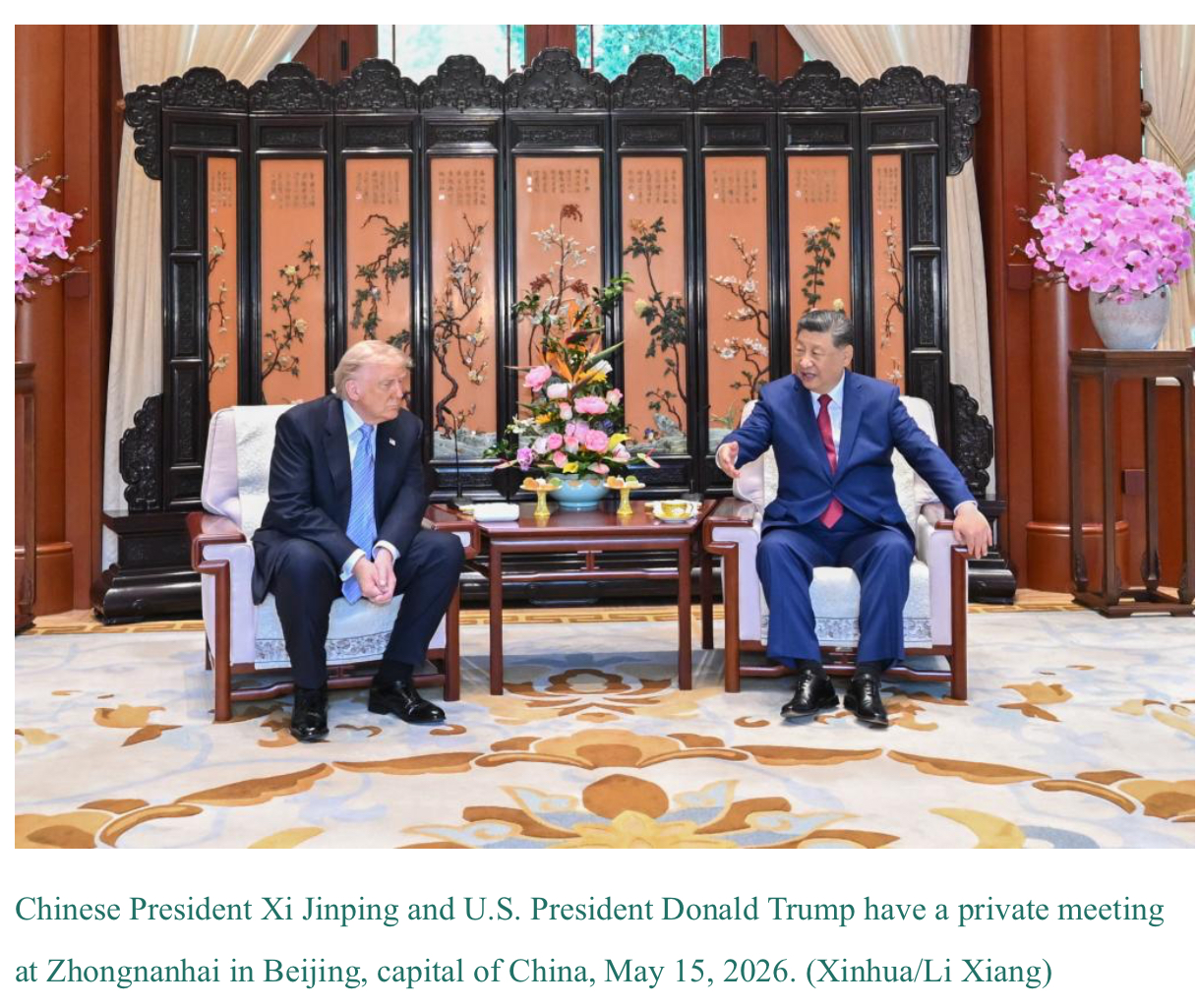
The relationship between the United States and China stands as one of the most significant in today’s world. Despite stark differences in political systems, historical trajectories, and cultural foundations, the two nations have long coexisted—though often marked by rivalry, mutual distrust, and persistent disagreements. Trade disputes, technology restrictions, and political tensions have frequently fueled global uncertainty. The latest Xi-Trump summit, however, hints at a potential turning point. U.S. President Donald Trump arrived in Beijing on Wednesday to begin his state visit to China at the invitation of President Xi Jinping. This marks another face-to-face meeting between the two leaders since their Busan meeting last October, and the first visit to China by a U.S. president in nine years. The summit between the heads of the world’s two largest economies carries considerable global expectations. Together, China and the United States account for more than one-third of global economic output, nearly one-quarter of the world’s population, and about one-fifth of international trade. As permanent members of the United Nations Security Council, the stability of their relationship is widely seen as essential to global peace, economic growth, and the resilience of industrial and supply chains. In today’s increasingly complex and turbulent international environment, the world is looking to Beijing and Washington for signals of cooperation and stability, hoping the two sides can help set a constructive direction for future relations. A stable China–U.S. relationship is a global public good. The high expectations surrounding this meeting stem from the irreplaceable role of head-of-state diplomacy in guiding China–U.S. relations. Over the years, despite periods of tension and uncertainty, the relationship has generally maintained overall stability—a notable achievement given its complexity and global significance. One day into US President Donald Trump’s visit to China for trade talks, both he and Chinese President Xi Jinping have exchanged toasts at the state banquet at the Great Hall of the People in Beijing, and hailed their relationship as the world’s most “consequential”. Xi spoke of a “shared US-China future”, while also warning that failure to handle this bond would create a “very dangerous situation”. He then posed a series of questions to the US president. “Can we join hands to address global challenges and inject greater stability into the world?” he asked. “Can we uphold the wellbeing of our respective peoples and the shared future of humanity, working together to create a bright future for our bilateral relationship?” Xi and Trump agreed to frame their relationship as “constructive, strategic and stable” in a new positioning that is intended to guide US-China ties for the next three years and beyond, according to a Chinese Foreign Ministry statement about talks between the two. “We are going to have a fantastic future together. I have such respect for China, for the job you’ve done. You are a great leader,” Trump told Xi. Trump also invited Xi and First Lady Peng Liyuan to pay a return visit to the White House on September 24. These messages are important because they show a willingness to reduce tension. Noting that China-U.S. relations concern the well-being of the over 1.7 billion people of both countries and affect the interests of the over 8 billion people of the world, Xi said both sides should rise up to this historical responsibility and steer the giant ship of China-U.S. relations forward steadily and in the right direction. A more stable and cooperative relationship between the United States and China is not only important for them, but also for the entire world. Together, they play a huge role in global trade, investment, and production. Their decisions affect prices, jobs, supply chains, and markets everywhere. When the relationship between them becomes tense, the effects are felt globally. Businesses face uncertainty, trade slows down, and costs increase. But when they cooperate, global trade becomes more stable, and the world economy benefits. It is not just about two countries—it is about global stability. In recent years, both sides have disagreed on trade policies, technology access, and security concerns. At times, it felt like the world’s two biggest powers were moving further apart. But the latest development shows something different: a willingness to talk again. Even if they do not agree on everything, the fact that they are meeting and discussing important issues is a positive step. During their talks, both leaders emphasized the importance of cooperation and peaceful relations. President Xi Jinping stressed that the two countries should avoid conflict and work together where possible. President Donald Trump also described the discussions as constructive and positive. These statements are important because they show that dialogue is still possible, even after years of tension. One of the strongest reasons to support better U.S.–China relations is the number of global problems that require cooperation. Climate change is one of the biggest challenges facing humanity. The United States and China are among the largest carbon emitters in the world. If they do not work together, it will be very difficult to reduce global emissions. However, if they cooperate on clean energy, green technology, and environmental protection, the impact could be huge. Joint action could speed up progress and benefit the entire planet. The global economy is closely connected. Many American companies rely on Chinese manufacturing, while many Chinese companies depend on American technology and markets.
When trade tensions rise, both sides suffer, and ordinary people around the world feel the impact through higher prices and reduced opportunities. Stable relations help create a healthier global economy. Many international security issues, such as regional conflicts, nuclear risks, and cyber threats, cannot be solved by one country alone. Communication between major powers is essential to avoid misunderstandings and reduce risks. When the United States and China communicate regularly, it lowers the chances of conflict caused by mistakes or misjudgments. It is important to be realistic. The United States and China will not agree on everything. They will continue to compete in areas such as technology, influence, and economic leadership. However, this does not mean they must be enemies. They may compete in business and innovation, but still work together on global issues like climate change and health security. This balanced approach is more practical than complete separation or constant conflict. History shows that when major powers stop communicating, the risk of conflict increases. Misunderstandings can grow quickly, and small problems can become serious crises. That is why dialogue between leaders is so important. Meetings between President Xi Jinping and President Donald Trump help create channels of communication at the highest level. Even when disagreements exist, regular contact can prevent escalation. As President Xi has said, cooperation, mutual respect, and peaceful coexistence are key to stable relations. This idea reflects the need for both sides to manage their differences carefully. Improved U.S.–China relations are not just about governments. They also affect ordinary people. When trade is stable, goods become more affordable. When relations are peaceful, students can study abroad more easily. Scientists and researchers can collaborate on medicine, technology, and environmental solutions. A more open relationship can also help businesses grow and create jobs in both countries and beyond. In short, better relations between the United States and China can improve everyday life for millions of people around the world. Of course, it is important not to be overly optimistic. There are still many disagreements between the two countries. Trust is not easy to build, and setbacks are likely. Political differences, economic competition, and security concerns will continue to shape their relationship. At times, tensions may rise again. But this should not stop efforts to engage. In international relations, progress is often slow and uneven. What matters is the ability to keep talking, even during difficult times. Some people believe that engaging with a rival is a sign of weakness. However, this is not true. Dialogue does not mean giving up strength or principles. In fact, it can show confidence. Strong countries are those that can protect their interests while still communicating with others. Talking helps prevent misunderstandings and reduces the risk of conflict. At the same time, cooperation must be fair and balanced. It should be based on mutual respect and clear agreements, not one-sided advantage. The world today faces problems that no single country can solve alone. Climate change, pandemics, economic instability, and security threats all require global cooperation. As the two most powerful countries in the world, the United States and China have a special responsibility. Their actions affect not only their own citizens, but billions of people everywhere. This makes cooperation not just an option, but a necessity.
A new era of U.S.–China engagement, if it continues, is a positive development for the world. It does not mean that all differences will disappear. It does not mean the end of competition. But it does mean something important: the willingness to talk, listen, and find common ground where possible. If both sides continue on this path, they can reduce risks, improve global stability, and work together on shared challenges. For the world, that is a welcome direction. For ordinary people everywhere, it offers hope for a more peaceful, stable, and connected future.This new direction is, therefore, worth welcoming.
Postscript: The writer is a journalist and this opinion piece is available for publication by any news outlet, nationally or internationally, on a non-exclusive basis. Editors are granted the right to make standard revisions for length, clarity, grammar, and house style. Opinions expressed r solely my own & don’t express the views or opinions of my employer.