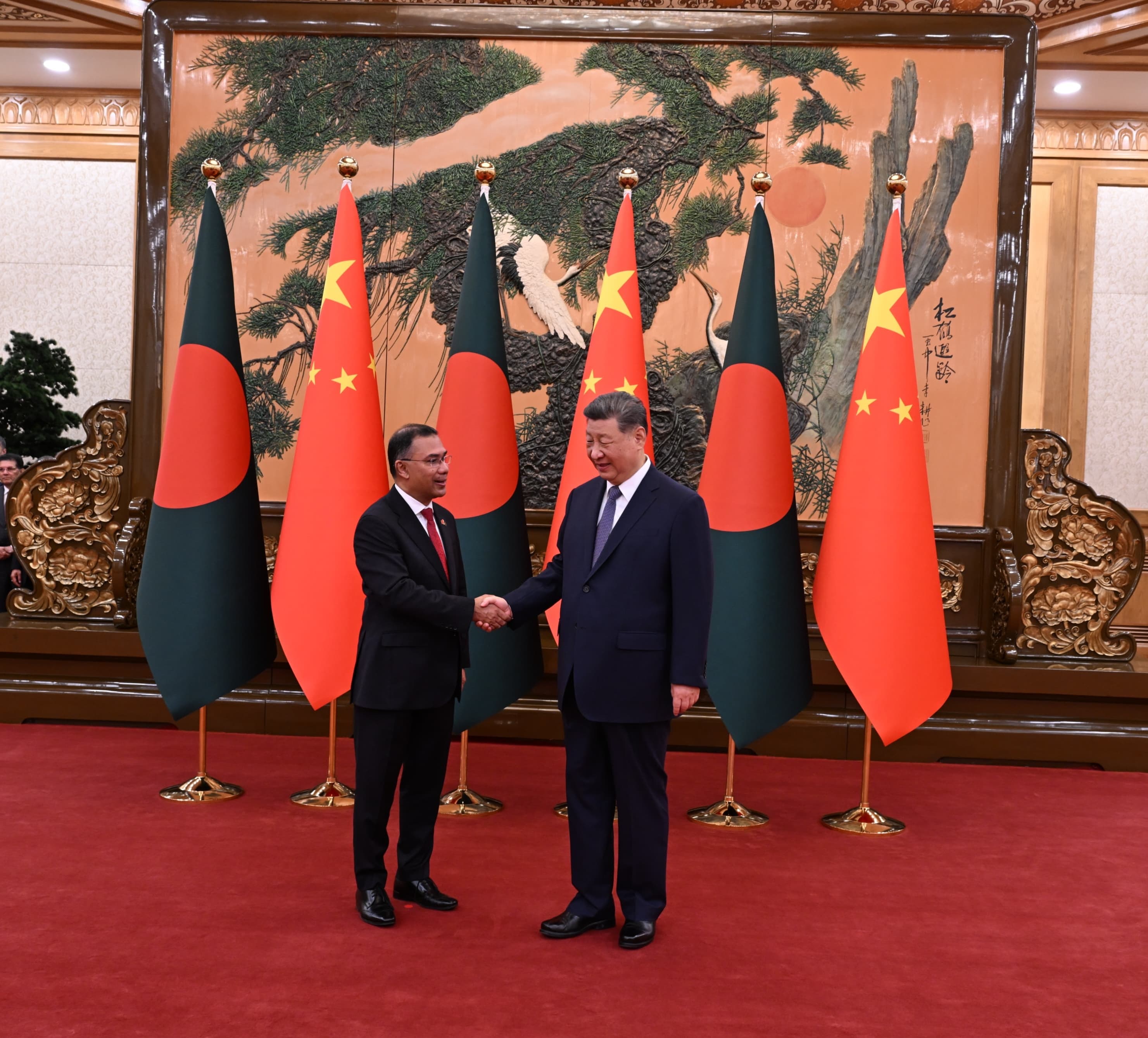
China, Bangladesh elevate ties, agree to deepen strategic cooperation during PM Rahman’s visit
BEIJING, June 26 (NsNewsWire) – China and Bangladesh agreed on Friday to elevate their relationship to a “China-Bangladesh community with a shared future in the new era,” pledging closer cooperation in trade, infrastructure, defense and diplomacy following Prime Minister Tarique Rahman’s first official visit to China since taking office.
The agreement came after talks between Chinese President Xi Jinping, Premier Li Qiang and Bangladeshi Prime Minister Tarique Rahman during Rahman’s June 22-26 visit, according to a joint communiqué released in Beijing.
China congratulated Bangladesh on holding its February 2026 general election and expressed support for the country’s new government and its “Bangladesh Before All” policy, while Bangladesh said China’s 15th Five-Year Plan would create new development opportunities for the South Asian nation.
The two countries agreed to establish a strategic dialogue mechanism between their foreign ministers and explore a “2+2” dialogue involving foreign and defense officials.
Bangladesh reaffirmed its support for Beijing’s “One China” policy, stating that Taiwan is an inalienable part of China and opposing any form of Taiwanese independence. China reiterated its support for Bangladesh’s sovereignty, independence and territorial integrity.
The two sides also pledged to expand cooperation under China’s Belt and Road Initiative, with Beijing promising continued support for Bangladesh’s industrialization and economic development.
Bangladesh welcomed China’s duty-free access for 100% of Bangladeshi tariff lines and agreed to create a favorable environment for Chinese investment. The two countries also committed to advancing the modernization and expansion of Mongla Port and developing the Chinese Economic and Industrial Zone in Chattogram.
China said it would support Bangladesh’s Teesta River Comprehensive Management and Restoration Project by helping accelerate feasibility studies and providing assistance within its capacity.
The countries also agreed to deepen cooperation in defense, climate change, renewable energy, science and technology, disaster management, education, public health, media and cultural exchanges.
On regional issues, China reiterated support for efforts to resolve the crisis involving displaced people from Myanmar’s Rakhine State who are sheltering in Bangladesh, while Bangladesh praised Beijing’s role in facilitating dialogue between Bangladesh and Myanmar.
China also backed Bangladesh’s efforts to play a greater role in multilateral institutions, including participation in BRICS and its application to become a partner of the Shanghai Cooperation Organization.
During the visit, the two sides signed multiple agreements covering development cooperation, agriculture, education, trade and investment, human resources and media cooperation.
Rahman thanked the Chinese government for its hospitality and invited China’s leadership to visit Bangladesh at a mutually convenient time. Enditem