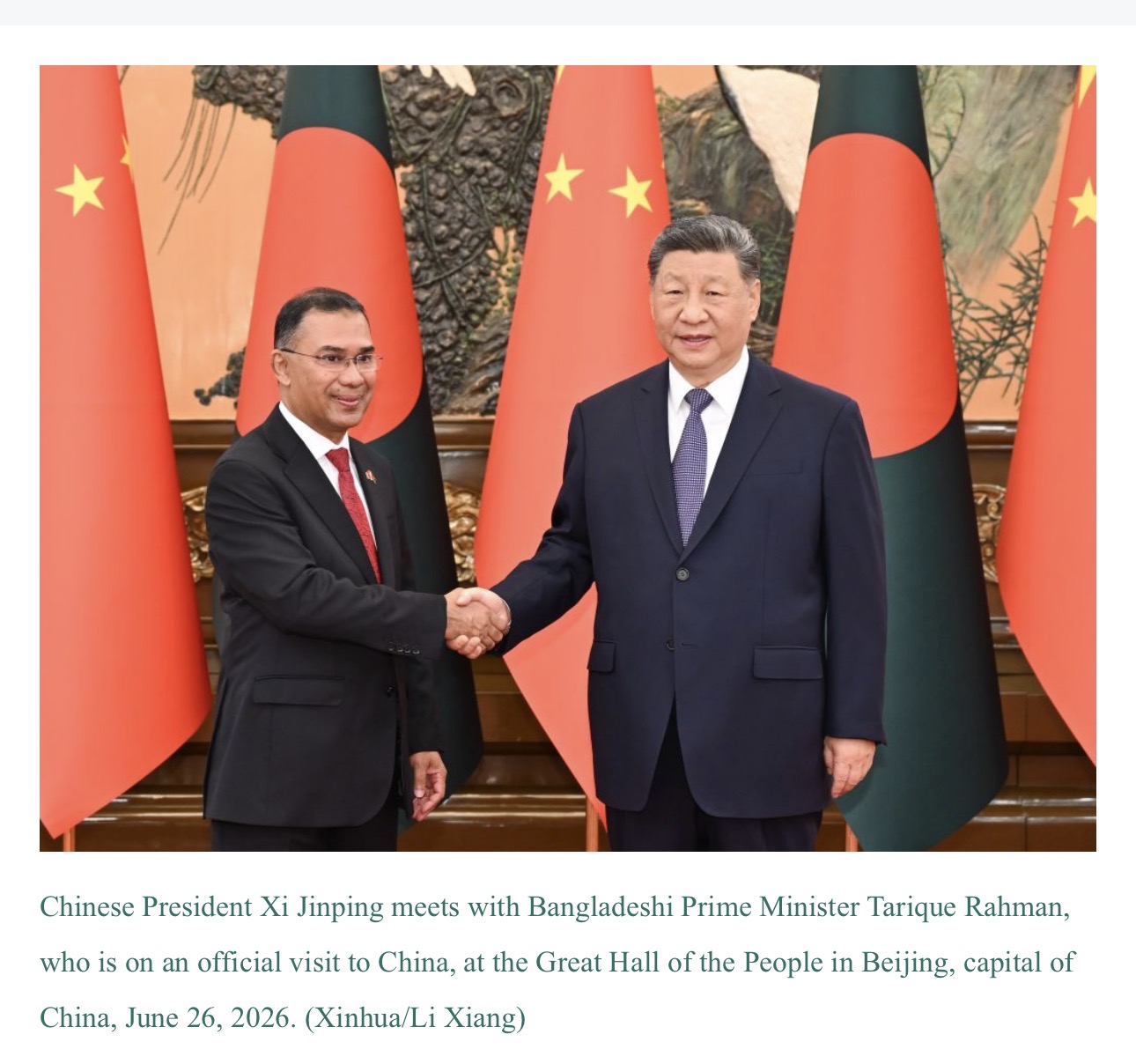
The Xi–Tarique summit: A landmark for Bangladesh-China relations
by Naim-Ul-Karim
Prime Minister Tarique Rahman’s first official visit to China has become one of the most important diplomatic achievements for Bangladesh in recent years. The visit was not just about meetings and ceremonies. It produced a strong joint statement that shows both countries are ready to work together more closely than ever before. By agreeing to build a “China-Bangladesh community with a shared future in the new era,” Bangladesh and China have taken their friendship to a new level. This visit sends a clear message that Bangladesh wants to build strong relations with all major partners while focusing on national development. China, as the world’s second-largest economy, is one of Bangladesh’s most important development partners. The new agreements and promises made during the visit can help Bangladesh create jobs, improve infrastructure, increase exports, and strengthen its position in Asia. One of the biggest achievements of the visit is China’s clear support for Bangladesh’s new government. Beijing congratulated Bangladesh on the successful general election held in February 2026 and expressed confidence in Prime Minister Tarique Rahman’s leadership. This recognition is important because it shows that China is ready to work closely with the new administration and support its development goals. PM Tarique Rahman government’s “Bangladesh Before All” policy also received recognition from China. This means both countries understand that every partnership should serve the interests of the Bangladeshi people. Development, investment, employment, and economic growth are now at the center of bilateral relations.
Trade was another major success of the visit. Bangladesh welcomed China’s decision to provide duty-free access to 100 percent of Bangladeshi tariff lines. This is excellent news for exporters. It gives Bangladeshi products a better chance to compete in one of the world’s largest markets. More exports can bring more foreign currency, create new factories, and provide employment for thousands of workers. At the same time, Bangladesh promised to create a friendly environment for Chinese investors. Chinese companies have already invested in roads, bridges, power plants, and industrial projects in Bangladesh. More investment means more industries, better technology, and new employment opportunities for young people. If managed properly, these investments can play a major role in transforming Bangladesh into a stronger manufacturing economy. Infrastructure development was another key outcome of the visit. The two countries agreed to continue working under the Belt and Road Initiative. They also decided to modernize and expand Mongla Port and move forward with the Chinese Economic and Industrial Zone in Chattogram. Better ports and industrial zones will improve trade, reduce transportation costs, and attract more international businesses to Bangladesh. Perhaps one of the most discussed announcements was China’s support for the Teesta River Comprehensive Management and Restoration Project. The Teesta is extremely important for the people living in northern Bangladesh. Better river management can improve agriculture, reduce flooding, and increase water security. China’s willingness to assist with feasibility studies and provide support within its capacity gives fresh hope that this long-awaited project may finally move forward.
The visit also strengthened political and strategic cooperation. The two countries agreed to establish a strategic dialogue between their foreign ministers and explore a “2+2” dialogue involving foreign and defense officials. This shows that Bangladesh and China want regular communication not only on economic issues but also on regional security and international affairs. Strong dialogue helps build trust and allows both countries to respond better to future challenges. Bangladesh also reaffirmed its support for the One China policy, maintaining a long-standing diplomatic position. In return, China once again expressed support for Bangladesh’s sovereignty, independence, and territorial integrity. Mutual respect for each other’s core interests has always been one of the strongest foundations of Bangladesh-China relations, and this visit reinforced that principle. Another positive outcome is the expansion of cooperation beyond economics. The two countries agreed to work together in renewable energy, climate change, science and technology, disaster management, agriculture, education, healthcare, media, and cultural exchanges. These sectors directly affect the lives of ordinary citizens. Better cooperation in education can create more scholarships for Bangladeshi students. Cooperation in healthcare can improve medical research and public health services. Collaboration in renewable energy can help Bangladesh reduce dependence on fossil fuels while protecting the environment. China’s continued support regarding the Rohingya crisis is also significant. Bangladesh has been carrying the heavy burden of hosting a large number of displaced people from Myanmar for many years. China reiterated its support for efforts aimed at resolving the crisis and praised dialogue between Bangladesh and Myanmar. Although the solution remains difficult, China’s active involvement could contribute to future progress. Another encouraging aspect of the joint statement is China’s support for Bangladesh’s greater role in international organizations. Beijing expressed support for Bangladesh’s participation in BRICS and its application to become a partner of the Shanghai Cooperation Organization. Such support can help Bangladesh diversify its diplomatic and economic partnerships while increasing its influence in global affairs.
The signing of multiple agreements during the visit further demonstrates that the relationship is producing practical results. Agreements covering agriculture, education, trade, investment, development cooperation, media, and human resource development provide a roadmap for future collaboration. Diplomatic visits are successful only when they produce concrete outcomes, and this visit achieved exactly that.
Prime Minister Tarique Rahman also deserves credit for presenting Bangladesh as a confident and forward-looking nation. Rather than focusing only on short-term gains, the visit emphasized long-term cooperation based on mutual respect and shared development. His meetings with President Xi Jinping and Premier Li Qiang reflected Bangladesh’s growing importance in regional diplomacy.
Of course, every international partnership should always be guided by Bangladesh’s national interest. Strong relations with China do not mean Bangladesh should neglect its friendships with other countries. Instead, Bangladesh should continue maintaining balanced relations with all major powers while protecting its independence and sovereignty. This balanced foreign policy has served the country well for decades and should continue in the future. The success of this visit should now be measured by implementation. Agreements and joint statements create opportunities, but real success depends on how quickly projects are completed, investments arrive, exports increase, and people benefit. Efficient governance, transparency, and proper planning will be essential to ensure that every promise made during the visit becomes a reality. Overall, Prime Minister Tarique Rahman’s China visit marks an important milestone in Bangladesh-China relations. The joint statement reflects deep trust, expanding cooperation, and shared ambitions for development. From trade and investment to infrastructure, education, technology, and regional diplomacy, the agreements have the potential to benefit millions of Bangladeshis.
If both governments continue to work sincerely and implement their commitments effectively, this visit may be remembered as the beginning of a new era of partnership. The friendship between Bangladesh and China has grown steadily over the years, and the latest agreements provide a strong foundation for even closer cooperation in the years ahead. For Bangladesh, this is an opportunity to accelerate economic growth, strengthen its international position, and move confidently toward a more prosperous future.
Postscript: The writer is a journalist and this opinion piece is available for publication by any news outlet, nationally or internationally, on a non-exclusive basis. Editors are granted the right to make standard revisions for length, clarity, grammar, and house style. Opinions expressed are solely his own & don’t express the views or opinions of his employer.