From ancient ties to new economic future: Why the Bangladesh-China-Myanmar Economic Corridor matters
by Naim-Ul-Karim
From ancient ties to new economic future: Why the Bangladesh-China-Myanmar Economic Corridor matters
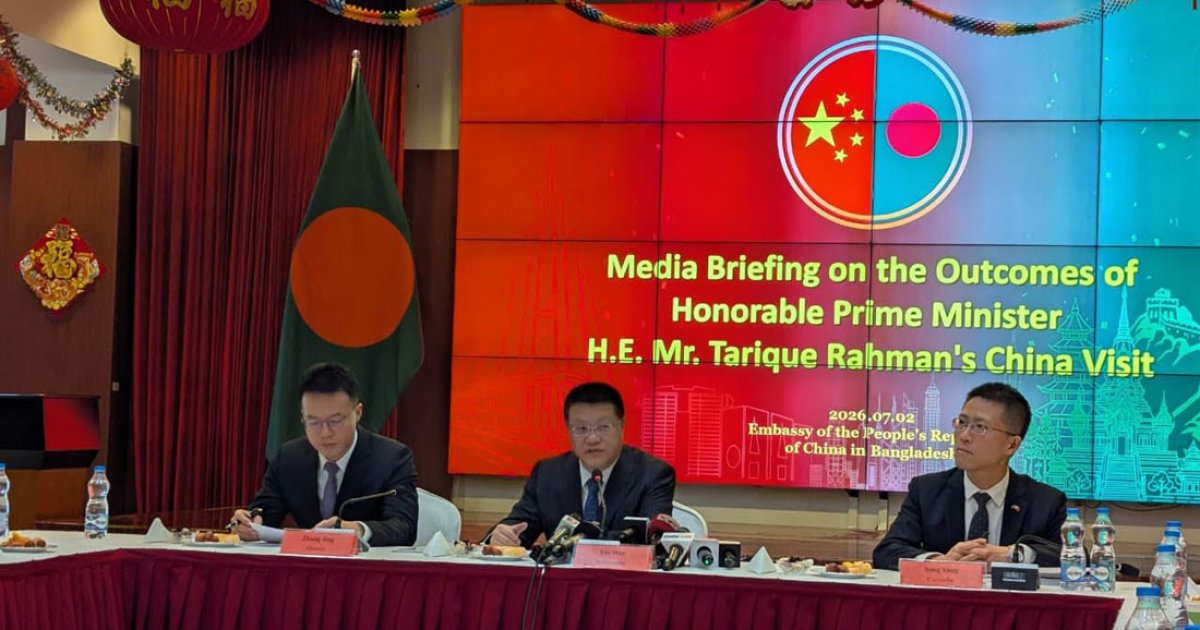
In the high-stakes theatre of regional geopolitics, the proposed Bangladesh-China-Myanmar Economic Corridor (BCMEC) has been viewed through a lens of suspicion by a particular segment of observers. Against this backdrop, Chinese Ambassador to Bangladesh Yao Wen has moved decisively to dispel these rumors, grounding the discourse firmly in connectivity and economic progress. His conspicuous clarification that other nations are welcome to join the table offers a refreshing antidote to zero-sum narratives, positioning the corridor as a bridge for unity rather than a wedge for division. This is not merely diplomatic posturing; the modern Dhaka-Beijing partnership has already reshaped Bangladesh’s physical and economic landscape. From sprawling industrial zones and digital grids to cross-river bridges and power plants, Chinese cooperation has left tangible footprints across the nation. Crucially, the concurrent transfer of technology in manufacturing, telecommunications, renewables, and transport is doing more than building infrastructure—it is quietly fortifying Bangladesh’s capacity to chart its own developmental destiny. During his press conference in Dhaka last week, the top Chinese diplomat addressed not merely speculation surrounding the BCMEC but clarified that its objectives extend beyond mere connectivity and economic growth. Long before modern diplomacy, international summits or ambitious infrastructure projects, the people of Bengal and China were already connected by ideas, trade and culture. More than a thousand years ago, Atish Dipankar, known as a venerated Buddhist scholar and philosopher, the travelled north, and his teachings later became deeply influential across Tibet and the Chinese Buddhist world. Because of his outstanding knowledge and wisdom, he was named Atish Dipankar Srigyan, which means “glorious wisdom source of light.” Around the same period, Chinese monks and travellers journeyed across South Asia, recording the region’s rich civilization and maintaining links with the ports of Bengal, including Chattogram, which had already emerged as an important centre of maritime trade. An important historical figure is the Chinese Buddhist monk Faxian (Fa-Hsien), who embarked on a 15-year pilgrimage (399–414 CE) from China to in this part of the world, becoming the first Chinese pilgrim to leave a comprehensive travelogue of his journey. In later centuries, other Chinese travellers, especially Xuanzang, also recorded valuable information about the region. Maritime contacts connected Chinese traders with the ports of Bengal, including Chattogram, helping promote trade and cultural exchanges across the Bay of Bengal. Those early exchanges remind us that Bangladesh and China are not strangers brought together by modern geopolitics. Their friendship is rooted in centuries of cultural contact, intellectual exchange and commerce. Today, that historic relationship is entering a new chapter with the proposed BCMEC which is a brainchild of Chinese President Xi Jinping. President Xi officially proposed the idea during a bilateral meeting with Bangladeshi Prime Minister Tarique Rahman at the Great Hall of the People in Beijing last month. This could become one of the most transformative development projects for Bangladesh and an important step toward greater regional integration.
Previously the Bangladesh-China-India-Myanmar (BCIM) Economic Corridor, designed to improve connectivity between the four neighbouring countries, lost momentum after India chose not to participate, the vision never disappeared. During Prime Minister Tarique Rahman’s recent visit to Beijing, Bangladesh and China reportedly agreed to revive the concept by working together with Myanmar, while leaving the door open for any other country willing to join in the future.
This is perhaps the most encouraging aspect of the proposal. Rather than allowing political disagreements to halt regional development, China has adopted an inclusive approach. Chinese Ambassador Yao Wen made this clear when he said that the corridor remains open to India and other countries whenever they are ready. His message reflects confidence rather than confrontation. Development does not have to exclude anyone. Countries willing to cooperate can move forward while welcoming others to participate later.
Bangladesh has achieved remarkable economic growth over the past few decades. It has become one of the world’s leading garment exporters, expanded its manufacturing sector and steadily improved its infrastructure. Yet the country’s future growth depends on stronger regional connectivity. Better transport networks mean lower business costs, quicker delivery of goods and easier access to international markets. The proposed corridor would connect Bangladesh with China’s Yunnan Province through Myanmar by road and railway. Such a connection would significantly reduce transport time and logistics costs while opening direct access to one of the world’s largest consumer markets. Bangladeshi exporters would gain new opportunities in China and Southeast Asia, while Chinese and regional investors would find Bangladesh an even more attractive manufacturing and logistics destination.
Infrastructure development is another major advantage. Roads, railways, ports, industrial parks and logistics centres supported by investment could strengthen Bangladesh’s long-term competitiveness. Better infrastructure is not merely about concrete and steel—it creates jobs, encourages private investment and improves productivity across the entire economy. The corridor could also transform Chattogram and Cox’s Bazar into even more important regional gateways. Bangladesh’s unique geographical position between South Asia and Southeast Asia gives it a strategic advantage that has not yet been fully realised. Improved connectivity would allow the country to become an important bridge linking these two dynamic regions.
The benefits would not stop at Bangladesh’s borders. Myanmar would receive greater investment and improved connectivity despite facing serious internal challenges. China would strengthen economic cooperation with South Asia while expanding trade through the Bay of Bengal. Greater economic interdependence often encourages greater stability, creating incentives for countries to maintain peaceful and productive relations.
China believes that economic development can contribute to stability in Myanmar’s conflict-affected Rakhine State. While development alone cannot solve complex political problems, greater investment, employment and infrastructure can provide better economic opportunities for local communities and support long-term peace. Prime Minister Tarique Rahman deserves recognition for helping revive this long-discussed initiative. His emphasis on regional connectivity reflects an understanding that Bangladesh’s next stage of development will depend not only on domestic reforms but also on stronger international partnerships. By engaging actively with China, his government has reopened an important conversation about Bangladesh’s regional economic future.Chinese President Xi Jinping also deserves appreciation for supporting the renewed momentum behind the corridor. Under his leadership, China has consistently promoted regional connectivity through infrastructure and trade cooperation. The consensus reached between President Xi and Prime Minister Tarique Rahman demonstrates that both countries see shared development as a priority.
Chinese Ambassador Yao Wen also deserves praise for presenting China’s position with clarity. By emphasising that the corridor is focused purely on connectivity and economic development—and by making it clear that participation remains open to other countries—he has reinforced the message that the initiative is intended to promote cooperation rather than division. The modern partnership between Bangladesh and China has already delivered important results. China is Bangladesh’s largest trading partner and a major development partner. Chinese cooperation has contributed to bridges, highways, power plants, industrial zones and digital infrastructure. Technology transfer in manufacturing, telecommunications, renewable energy and transport has helped strengthen Bangladesh’s development capacity.
The proposed economic corridor can build upon these achievements by creating an integrated network of trade, investment and innovation. It offers Bangladesh an opportunity not simply to improve transport links but to become a regional centre for logistics, manufacturing and commerce. Of course, ambitious projects require careful planning. Financial sustainability, environmental protection, transparency and consultation with local communities must remain central to implementation. Success will depend on responsible governance and practical cooperation among all participating countries.
History teaches us that connectivity has always driven prosperity. The ancient exchanges between Bengal and China enriched both civilizations through trade, knowledge and cultural understanding. Today’s Bangladesh–China–Myanmar Economic Corridor represents a modern continuation of that tradition. If implemented wisely, it can become far more than a transport route. It can serve as a bridge between South Asia and Southeast Asia, generate employment, strengthen regional supply chains and improve the lives of millions of people. The ancient friendship between Bangladesh and China has already stood the test of time. The proposed Bangladesh–China–Myanmar Economic Corridor offers an opportunity to transform that historic relationship into a shared economic future—one based on connectivity, cooperation and common prosperity. It is an opportunity that deserves serious attention and determined action.
Postscript: The writer is a journalist and this opinion piece is available for publication by any news outlet, nationally or internationally, on a non-exclusive basis. Editors are granted the right to make standard revisions for length, clarity, grammar, and house style. Opinions expressed are solely his own & don’t express the views or opinions of his employer.