Tarique Rahman’s “life-friendly budget”: A new dawn for prosperous Bangladesh
by Naim-Ul-Karim
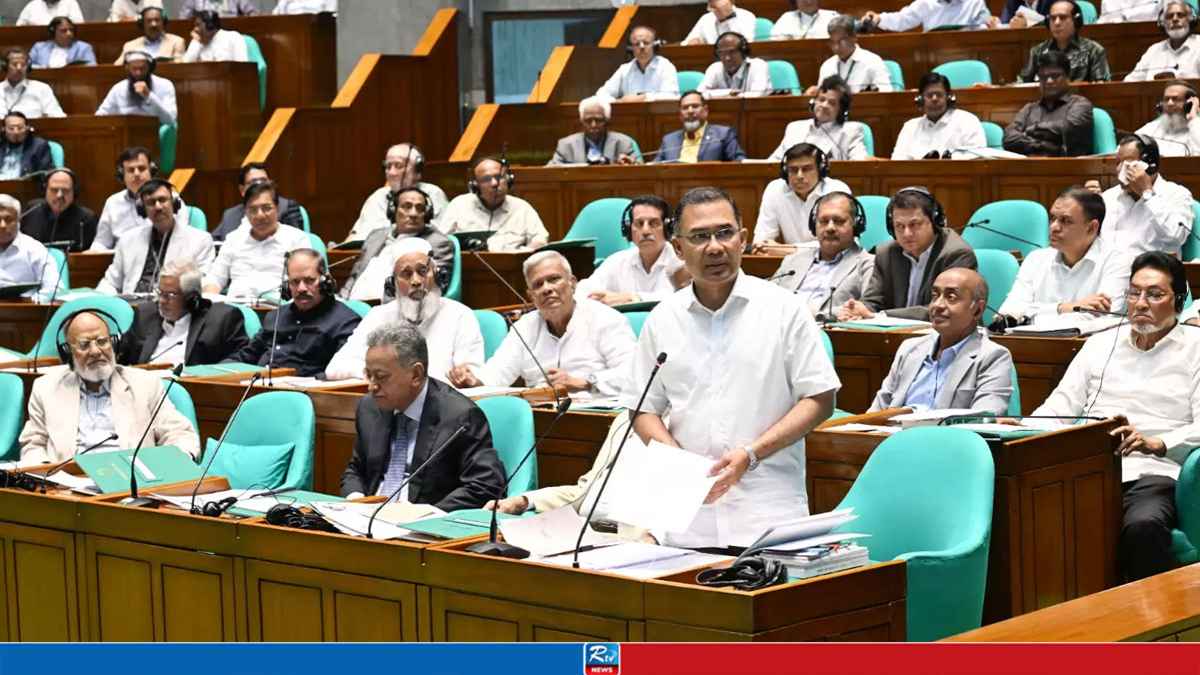
Prime Minister Tarique Rahman’s address to Parliament on Monday marked a defining moment for Bangladesh. As he joined the general discussion on the proposed FY2026-27 (July 2026-June 2027) national budget, he gave it a name that resonates with hope and purpose—the “Jibon Bandhob Budget” or “life-friendly budget”. This is not merely a fiscal document; it is a declaration of intent, a roadmap for rebuilding a nation battered by years of corruption and mismanagement. What makes this budget truly remarkable is its unwavering focus on the common citizen. The Prime Minister rightly observed that no budget can solve every problem overnight. Yet, the government has made every effort to craft a fiscal plan that offers tangible relief to people from all walks of life.
The most immediate and visible relief comes from the withdrawal of taxes and duties on 61 essential commodities. In previous years, Bangladeshis would brace themselves for sudden price hikes before and after budget announcements—often without any clear justification. This time, however, prices remained stable. As the Prime Minister noted, “By the grace of Almighty Allah, we did not witness such abnormal increases this time”. For a nation where every taka matters to millions of families, this stability is no small achievement.
Bangladesh remains an agricultural nation at heart, and this budget honours that reality. The government’s first major decision after assuming office was to waive agricultural loans of up to Tk10,000, including interest—benefiting around 13 lakh farmers. Now, the introduction of a special Farmers’ Card promises direct financial support, with 43 lakh farmers expected to receive assistance along with ten additional services during the upcoming fiscal year.
Perhaps most significantly, the Prime Minister has pledged to implement the Teesta Barrage Master Plan “at any cost” as a national priority. This is not just about water management—it is about the very survival of communities in the northern districts of Rajshahi and Rangpur. Alongside this, the government has already begun work on the Padma Barrage to preserve surplus monsoon water for dry seasons. Furthermore, plans to excavate and re-excavate 20,000 kilometers of canals over the next five years will address regional imbalances in water distribution. Nearly 900 kilometers have already been completed in just three months. The promise is clear: no farmer should suffer from water scarcity when water is abundant just a short distance away.
The Prime Minister’s tax proposals demonstrate a genuine commitment to easing the burden on ordinary citizens. He proposed raising the tax-free income threshold to Tk400,000 for FY27 and FY28, Tk450,000 for FY29 and FY30, and Tk500,000 for FY31—an increase from the originally proposed lower thresholds. In a move that reflects responsiveness to public sentiment, the Prime Minister also urged the withdrawal of several controversial provisions. The proposed measure relating to voluntary disclosure of investments had generated widespread concern, with many interpreting it as an opportunity to legalize black money. The Prime Minister, respecting public opinion, requested its withdrawal. Similarly, he called for the removal of provisions making TIN certificates mandatory for opening bank accounts and registering property mutations.
Other proposals further demonstrate the government’s pro-business and pro-people stance: reducing the income tax rate for private universities from 10% to 5%, expanding tax exemptions for indigenous communities, eliminating duties on shrimp farming inputs, and reducing import duties on industrial raw materials like PVC and PET resin.
The Prime Minister did not shy away from acknowledging the difficult reality his government inherited. He spoke frankly about a “broken economy” marked by corruption, looting, mismanagement, and policy failures. Thousands of crores of taka were siphoned out of the country. Production and investment had nearly stagnated. Inflation had reached levels that people could feel in their daily lives. The stock market had become a place where people lost everything—some even took their own lives.
Yet, the Prime Minister’s message was not one of despair but of resolve. “We do not deny the economic challenges exist, nor do we want to use them as excuses,” he said. The government has already sent 23 Mutual Legal Assistance Requests to 13 countries seeking cooperation in tracing and recovering laundered assets. More than 60 non-disclosure agreements have been signed with international asset recovery organizations.
Beyond the numbers and policies, what truly stands out is the Prime Minister’s vision for the nation. He called on lawmakers across party lines to view the budget as a roadmap for nation-rebuilding—not merely as the government’s budget. He spoke of building a Bangladesh where “development is based on fairness, the economy is inclusive, the state is welfare-oriented, and citizens enjoy a safe, dignified, and promising life”.
The emphasis on good governance is equally encouraging. The Prime Minister stressed the need for a professional, honest, and efficient civil administration, an independent judiciary to protect democracy and human rights, and national unity to ensure that no form of fascism or authoritarian rule can return.
The FY2026-27 budget, with its life-friendly orientation, represents more than just a fiscal plan. It is a statement that Bangladesh is ready to turn the page on a difficult chapter and embark on a journey of renewal. The path ahead will not be easy—the Prime Minister himself acknowledged the difficulties. But with a clear vision, a commitment to justice, and policies designed to bring relief to every citizen, this government has laid a strong foundation for the future. As the Prime Minister rightly said, “I believe the people of this country want us to talk about the future”. This budget does exactly that. It talks about a future where farmers have water for their fields, where families can afford essential goods, where young people find employment, and where every citizen can live with dignity. It is, indeed, a life-friendly budget for a nation ready to rebuild and prosper.
The “Jibon Bandhob Budget” is undoubtedly a bold and compassionate fiscal blueprint that promises relief and renewal for Bangladesh. However, the true test lies not in its formulation but in its implementation. History shows that even the most well-intentioned budgets have faltered in Bangladesh due to weak execution, bureaucratic bottlenecks, and systemic corruption.
The challenges ahead are significant. Expanding the tax base remains a formidable task, as a large portion of the economy operates outside the formal sector. Implementing the ambitious canal excavation plan requires coordinated efforts across multiple ministries and local governments. Recovering laundered assets—though a commendable goal—depends heavily on international cooperation and complex legal processes. Additionally, the proposed tax concessions and waivers may strain government revenues, potentially affecting funding for critical infrastructure and social programs.
To overcome these hurdles, several measures are essential. First, the government must strengthen institutional capacity by investing in training and technology for revenue collection agencies to improve efficiency and transparency. Second, regular monitoring and evaluation mechanisms should be established, with quarterly progress reports made public to ensure accountability. Third, the government should engage civil society organizations and local communities in implementation—particularly for water management projects—to ensure grassroots participation and oversight. Fourth, digitization of public services must be accelerated to reduce bureaucratic delays and minimize opportunities for rent-seeking. Finally, political will remains the most crucial factor. As Prime Minister Tarique Rahman rightly emphasized, national unity and cross-party cooperation are vital. If all stakeholders—government, opposition, civil society, and citizens—work together, Bangladesh can transform this life-friendly budget from a visionary document into a tangible reality. The journey will be challenging, but the destination—a prosperous, just, and dignified Bangladesh—is well worth the effort.
Postscript: The writer is a journalist and this opinion piece is available for publication by any news outlet, nationally or internationally, on a non-exclusive basis. Editors are granted the right to make standard revisions for length, clarity, grammar, and house style. Opinions expressed are solely his own & don’t express the views or opinions of his employer.